Fire Escape Inspection Requirements: The 5-Year Rule Explained
Fire escapes require inspection every 5 years under most adopted codes. Learn what's evaluated, who's responsible, and what to do if you don't know your status.
The 5-Year Fire Escape Inspection: What It Is and Who's Responsible
If your building has a fire escape or another exterior means of egress, there's one question worth answering right now:
When was it last professionally inspected?
If you can't answer that quickly, you're not alone. More importantly, it's worth finding out.
Fire escapes are life-safety structures that spend decades exposed to rain, snow, and temperature swings. Under commonly adopted fire and building codes, they're subject to inspection — and in some cases load testing — on a recurring five-year cycle. That's why fire escape inspection requirements exist: a structure that lives outdoors for decades needs to be checked before neglected maintenance becomes a life-safety problem.
What Is a 5-Year Fire Escape Inspection?
A five-year fire escape inspection is a periodic professional evaluation of an exterior means of egress. The inspector evaluates its structural components, connections, and anchorage to determine whether the system can still perform safely.
Depending on the circumstances and the jurisdiction, that process may involve a visual inspection alone. It may also require load testing or additional verification before the system can be considered fully compliant.
This isn't a walk-by.
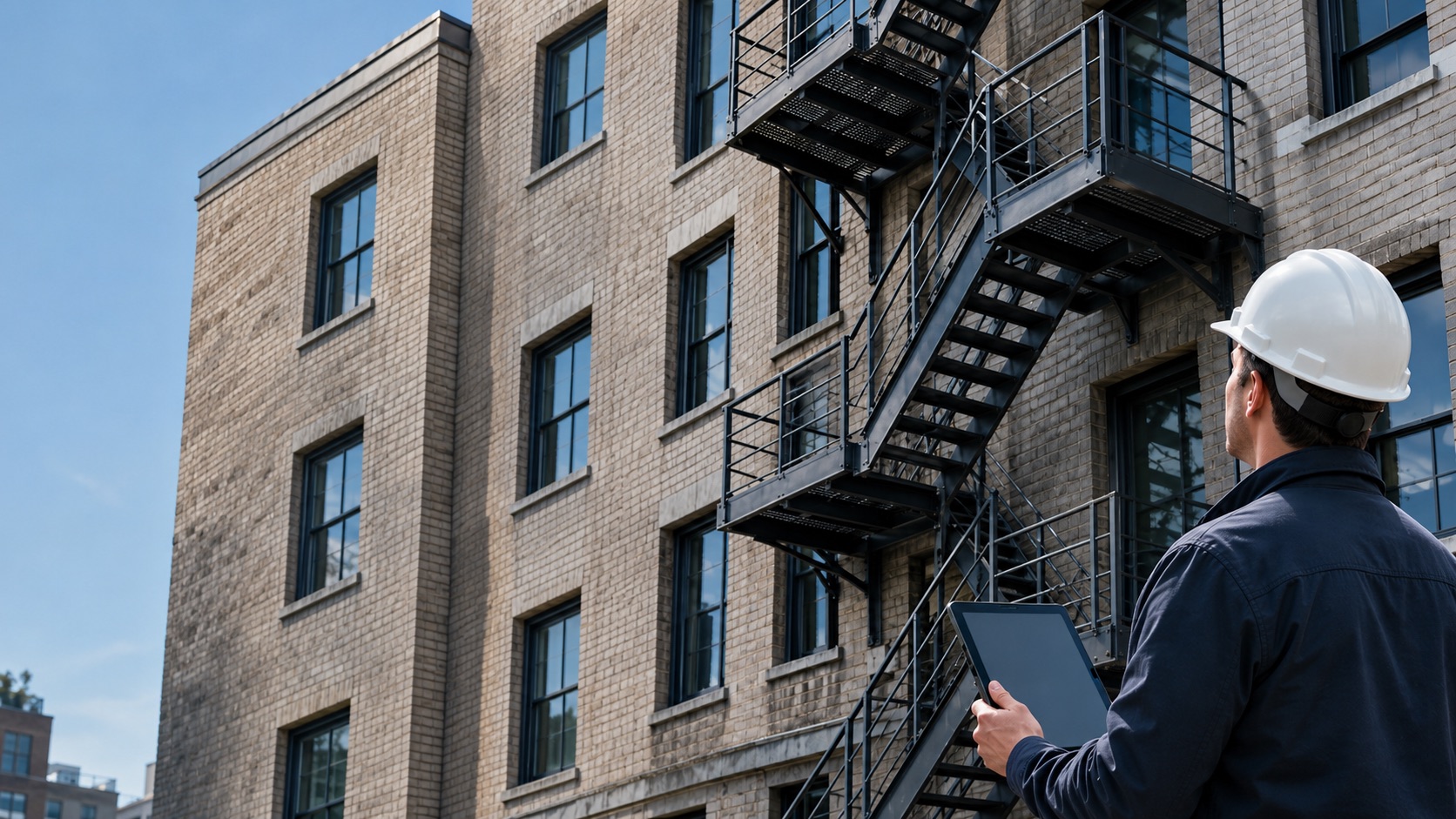
A qualified inspector physically examines the system from the ground up: platforms, stairs, railings, supports, bolts, welds, and the points where the fire escape connects back into the building.
The goal is straightforward: confirm the structure can still do its job.
In practice, that typically means demonstrating it can carry a minimum bearing load — commonly cited at 100 pounds per square foot — and withstand roughly 200 pounds of lateral force at the railings, per applicable testing standards.
The exact requirements vary by the codes a state or municipality has adopted and by the local Authority Having Jurisdiction (AHJ).
Why Every Five Years?
Steel deteriorates continuously once it's exposed to moisture and air. A routinely maintained system with paint helps protect it, but coatings don't last forever.
Once that protection fails, corrosion begins deteriorating the steel underneath.
The five-year cycle is designed to catch that deterioration before it moves from a coatings problem to a structural one. It's less about paperwork than it is about checking an aging system before years of skipped maintenance compound into something serious.
Who Is Responsible for the Fire Escape Inspection?
The property owner.
That responsibility doesn't move, even when the day-to-day work gets delegated.
What Owners Are Accountable For
The building owner is responsible for making sure the property maintains its inspection and certification status — full stop.
That remains true whether the owner manages the property directly or hires someone else to handle it.
What Property Managers Actually Handle
When an owner delegates to a property management company, the manager is typically the one tracking dates, locating vendors, scheduling access, and retaining documentation.
But delegation moves the work, not the accountability.
If a required inspection is neglected, the violation sits on the building the owner holds title to — regardless of who dropped the ball.
The same basic logic applies to elevator certification or fire sprinkler compliance: someone can be hired to manage the process, but the owner still owns the outcome.
Are Tenants Responsible?
No.
Building occupants may need to be notified when an inspector will be outside their windows, but arranging or paying for the inspection is a property-level obligation — never a tenant one.
Who Enforces This — And Who Doesn't
One of the most common misunderstandings about this requirement involves the local fire or building department.
The AHJ enforces the requirement. It doesn't perform the inspection.
Depending on the jurisdiction, the AHJ may be the fire department, building department, or another local office. Its role is to maintain compliance records, request documentation, and — when a certification lapses — issue warnings or violations.
What it generally does not do is send a qualified professional to your property to evaluate the fire escape.
That's a third-party job, handled by a registered design professional, structural engineer, or another inspector accepted by the local AHJ — such as the registered design professionals at Fire Escape Engineers. (Who exactly qualifies varies by jurisdiction — see our guide on hiring a legitimate fire escape inspector for the specifics.)
Ignoring this obligation can become more than a paperwork problem. An overdue inspection can escalate into a code violation, complicate an insurance claim, or create financial and legal exposure if something goes wrong before the issue is addressed.
The full picture of what's at stake is covered in Insurance, Liability, and What Happens After a Fire Escape Fails.
Don't Wait for the City to Remind You
Enforcement infrastructure is wildly inconsistent from one municipality to the next.
Some cities track certification dates and send notices when a building falls overdue. Many others don't have the staff or systems to do that at all.
The absence of a notice tells you nothing about your compliance status.
It only tells you that nobody's watching — which is precisely why owners need to track their own dates rather than treating city silence as a green light.
A fire escape spends most of its life unused, sitting quietly outside while other building systems — elevators, boilers, sprinklers — get routine attention because someone remembers they exist.
A fire escape gets remembered when someone needs it. By then, it's too late to discover it wasn't ready.
What an Inspector Actually Evaluates
Every fire escape tells a story, and an experienced inspector investigates it almost like a detective would.
Paint condition is the first clue. A well-maintained coating protects against corrosion. When that coating begins failing, surface rust becomes visible — not an automatic red flag, but evidence that the protective layer has stopped doing its job in that spot.
The longer that goes unaddressed, the more a cosmetic problem can move toward one that affects the steel's load-bearing capacity.
Connections matter more than surfaces. A fire escape can look acceptable from a distance while deterioration develops where you can't see it from the sidewalk.
Bolted joints, welds, and anchorage points can hide a condition called rust jacking — corrosion developing inside a connection and forcing components apart from within.
That's why fasteners and welds can fail suddenly, with no warning.
A joint can look solid from a distance and still be failing underneath.
That's exactly why a real inspection means physically examining the structure and connections, not photographing it from the ground.
Inspection vs. Certification: Not the Same Thing
This distinction matters, and it's one of the most common points of confusion.
An inspection establishes the current condition. Certification is the completed compliance outcome.
Depending on what the inspection finds and what the jurisdiction requires, the next step may involve no corrective work, load testing, repairs, or another required compliance step. (The full breakdown of certification paths is covered in From Inspection to Certification: The Three Paths.)
The short version: you can hold an inspection report without holding a valid certification.
Knowing the difference keeps owners from assuming that a completed inspection means the obligation is closed.
What If You Don't Know When Your Fire Escape Was Last Inspected?
Owners change. Property managers change. Paperwork gets lost in an office move or buried on a computer nobody can access anymore.
If you don't know your status, don't assume that means you're current.
Here's how to find out.
Step 1 — Check Your Own Records
Start with what you already have. Look through paper files, digital folders, prior inspection reports, certification documents, or anything passed along by a previous owner, property manager, or vendor.
Step 2 — Check Whether Your City Has a Public Database
Some municipalities maintain public permit or compliance databases where owners can search their property directly. (Boston is one example of a city offering this kind of public lookup — verify current availability before publication.)
Not every city offers this, but it's worth a quick check before assuming nothing exists.
Step 3 — Contact the Local AHJ
If your own records come up empty and no public database is available, contact the local fire department, building department, or applicable AHJ directly.
Ask whether they have any fire escape inspection or certification documentation on file for your property.
If you've owned the property for years and already know the fire escape has never been inspected or certified during that time, you may already have your answer.
At that point, the next step isn't more searching — it's addressing the overdue inspection.
What to Do Next
If you know your certification status, keep the documentation accessible and track the next required date. If you manage several properties, keep those dates in one place rather than relying on the city to flag them for you.
If you don't know your status, start with the three steps above. Or — would you like us to take the reins on this process for you? Check out our Free Evaluation below to book a call with us.
An old fire escape isn't automatically a bad one. Structures that are properly inspected and maintained can remain serviceable for generations.
Neglect — not age — is the actual risk.
(If you're preparing to sell a building, fire escape status becomes a due-diligence item — see Selling Your Building? Why the Fire Escape Cert Comes First.)
Not Sure Where Your Fire Escape Stands?
You don't need to solve everything today.
You just need to know where you stand.
Start with what you can check yourself. Look through your own records first. If that doesn't turn up an answer, see if your city offers a public compliance database or contact the local AHJ directly.
Still unsure? That's what the Free Evaluation is for.
You don't need to commit to a full inspection just to understand where you stand.
Share a few photos of your fire escape and whatever documentation you already have, and Fire Escape Services Network (FESN) will help you understand what you're looking at and what — if anything — may need to happen next.
If further work is needed, FESN can help coordinate the path forward — from inspection and load testing to repairs, painting, and certification — through its network of qualified professionals.
Keeping a fire escape inspected and maintained isn't ultimately about paperwork.
It's about making sure that exterior means of egress is ready for building occupants and first responders if the day ever comes when it's actually needed.
Frequently Asked Questions
Does every fire escape need to be inspected every five years?
Under commonly adopted fire and building codes, yes — the five-year cycle applies broadly to exterior means of egress. Some jurisdictions layer on additional local requirements, so it's worth confirming specifics with your local AHJ.
Does the fire department perform the inspection?
No. The AHJ — which may be the fire department, building department, or another local office — enforces the requirement, but the actual inspection is performed by a qualified third-party professional.
If my property manager handles compliance, am I still responsible?
Yes. Delegating the work doesn't transfer accountability. As the owner, the compliance obligation remains yours regardless of who manages the process day to day.
What counts as a fire escape for inspection purposes?
Exterior means of egress generally include steel, wood, concrete, and hybrid systems — not just the classic iron staircase. (For the full breakdown of what qualifies, see Is It Even a Fire Escape?.)
Does passing an inspection mean my fire escape is certified?
Not always. Passing a visual inspection doesn't automatically mean the fire escape is certified in every jurisdiction — depending on the AHJ and applicable requirements, additional verification such as load testing may still be required before certification is complete. See our certification-paths guide for the full picture.
What happens if I sell a building without a current certification?
This can complicate or delay a sale. If you're evaluating a transaction, this is worth addressing well before closing — see our guide on certification and building sales.
How much does a fire escape inspection cost?
Cost depends on several factors — building size, number of stories, the size and complexity of the fire escape itself, site access, and the type of provider you use. See our fire escape inspection cost guide for published starting ranges.